Translate

Posts in English लेबल असलेली पोस्ट दाखवित आहे. सर्व पोस्ट्‍स दर्शवा

रविवार, २१ डिसेंबर, २०१४

Winter special Millet balls aka Bajra Ladoos


Ingredients:-

3 cups Millet (Bajra)flour,
1.5 cup grated jaggery,
1 cup Clarified butter aka ghee,
1 tbsp cardamon powder,
2 tbsp dry ginger (soonth) powder,
1/4 cup milk (optional)

Method:-


1. In a pan roast millet flour in clarified butter for @ 15 min on medium flame. 
2. Add grated jaggery, cardamon and dry ginger powder. Mix well. 3. Let it cool down a bit. Check if you can roll into balls or ladoos. 4. If necessary add milk n roll into nice balls ladoos. 

Perfect for winter healthy breakfast! To kick start day on a healthy note. Found preparing ladoos is good exercise for hand, wrist, palm and  fingers. So surely one can enjoy that without feeling guilty.  ;-)


मंगळवार, १८ नोव्हेंबर, २०१४

Brahmi Chutney

Here I am once again sharing my new experiment in kitchen. In my last blog entry I had written about Thankuni Pata (Bengali name) aka Brahmi or mandukparni ( Sanskrit, Marathi and Hindi name) aka Centella asiatica ( English name). Before coming to Dhaka, I had read, heard about Brahmi in my Basic Ayurveda studies. Here, for the first time, I am actually seeing and using this medical plant,...as vegetable ! Last evening, finally I tasted it in form of chutney. 

While writing this, I googled about Brahmi just out of curiosity. Ohh! it's so useful they say. Brahmi is good for stomach diseases, it is used for treating anxiety, it is good for glowing skin ...and the list goes on. I was just knowing that its good for brain functions, memory and that Brahmi oil is good for hair growth. 

 So here is the recipe. 


Ingredients:-

25-30 Brahmi leaves,

6-7 Garlic cloves,

2 Green chillies,

1 tsp onion seeds,

and salt as per taste.

Method:-

Remove the stems of Brahmi leaves. Wash the leaves and strain the water. In a mixer jar put all the ingredients and make fine paste. Your healthy and hot chutney is ready.

Bengali people do eat this chutney with rice. I tried it with vadas and with chapati. My son had brahmi chutney in his sandwich. :-).

This chutney was so hot (basically because of chilies and garlic), that it made my tongue numb and nose run. But I liked it that way!

If you find these leaves please do try this chutney. I loved it. Hope you will also like it.


बुधवार, ५ नोव्हेंबर, २०१४

My lab for experiments and the studio for creativity

Namoshkar, Salaam from Dhaka.

After a long break, happy to post this new entry in my blog. The very first in the new folder named, " Dhaka Diary". New episode has begun with new surroundings, new set of people around and of course with new routine.  Life is getting charged here. 

Sabse se pehle to papi pet ke sawal ka jawab dena hota hai ! 

So eventually food, eating comes first! And Kitchen becomes my lab for experiments and the studio for creativity. 

Here I am ordering my groceries online. I am finding it very comfortable and time saving. The first time I opened the website and clicked the veggies option I found quite a few unfamiliar/exotic veggies.  I was surprised to find the strange pictures and names like thankoni pata and kolmi shak. I have started exploring them.  I googled to know their English, Sanskrit and Marathi names. That thankoni pata was none other than brahmi, very well known in Ayurvedic usage. The kolmi shak is water spinach in English, kalamba in Sanskrit and नाडी ची भाजी in Marathi. No doubt an addition to my knowledge. I have yet to try both of these plants. 

Surprised to find Mehendi leaves in the veggies list. Yes, I used that! Hope you are not thinking that I made chutney ;-). I ground the fresh Mehendi leaves in yogurt and applied that on hair.  Here is the pic of Mehendi chutney, natural hair tonic.


Last time I ordered lemons and got this thing. Here is the pic. what do you think it might be?


At first, I thought it's guava. Actually, it was what we call - Idlimbu. The leaves had a strange, peculiar aroma. So, I boiled those leaves in drinking water. That taste of water refreshed my sweet memories of our Bangkok visit and Thai food. Came to know that Idlimbu is from the family of Kaffir lime.  Made sharbat out of it. It's taste and aroma was closer to Kaffir lime. Loved that !

Today got  kaccha haldi aka raw turmeric and tried this healthy and yummy pickle. Its one my favorite pickles. Have added lemon juice, ground mustard seeds, methi dana, sauf, salt and til oil in it. Perfect !


Hope you enjoyed reading this. 
See you soon! Abbar dekha hobe!!!


शुक्रवार, २ मे, २०१४

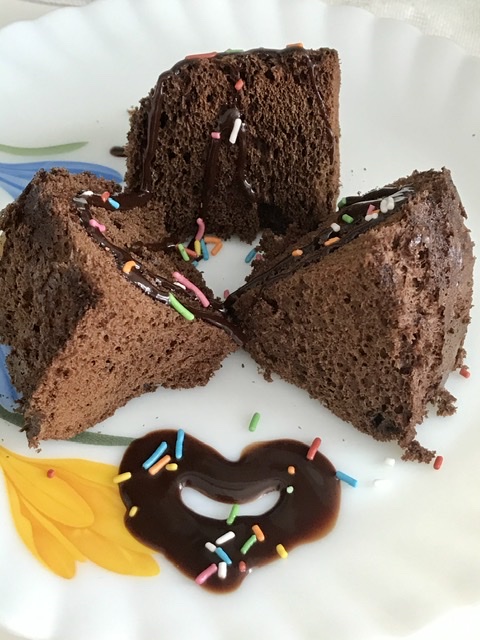
Super easy chocolate cake

Yesterday, for the first time I tried microwave for baking a cake. Actually, this cake making activity was a spontaneous one. So obviously I was not having all the necessary ingredients like, vanilla essence and cocoa powder. Yet,  I experimented  with substitutes and to my surprise, it came out quite well. Here is the (super easy, time and efforts saving) recipe for my all busy friends.
 
Ingredients 
1/2 cup white flour aka maida,
1 tsp baking powder,
1/2 cup sugar,
2 eggs,
2 tbsp Clarified butter aka ghee,
2 tbsp chocolate flavor horlicks  (as I was out of cocoa powder)
1/4 cup milk.

Method
1. Sift flour with baking powder for 3-4 times. 
2. Grind the sugar in grinder. 
3. Add eggs in a juicer with the sugar. Run through the juicer, on minimum speed, till the mixture becomes double in volume.
4. Add ghee in the juicer. Run through the juicer, on medium speed for @40 sec.
5. Add sifted maida and baking powder in the juicer. Again run through the juicer ( slowly increasing the juicer speed) for @ 40 sec.
6. Add chocolate flavor horlicks and milk in the juicer. Run through the juicer for @ 40 sec. on medium speed. 
7. Grease a microwave safe container with ghee. Pour the batter. Microwave uncovered for 5 minutes. 
8. Let it stand for few more minutes. Once it cool off take it out from the container. 

Try it out and share the experience.  :-)


मंगळवार, ५ नोव्हेंबर, २०१३

Meeting Gurudev in China

I had an opportunity to watch Rabindranath Tagore’s play “Visarjan” (Sacrifice), in Mandarin ( Chinese )!

It was awesome!

I watched the play in China which, unfortunately, I couldn't watch in India. :-)

It was a tribute to Indian artists by Chinese artists!

Young Chinese artists had all presented Visarjan beautifully. They had actually brought all the characters alive. All the characters’ Indian names: Aparna, Jaisingh, Raghupati, Govinda and Gunavati etc. were sounding very sweet, when uttered in Chinese diction:-). 

Moreover, it was a great pleasure to watch Chinese artists in Indian costumes playing many roles such as king, queen, and priest.

And besides the stage, there was a huge screen displaying English subtitles. What made me really disappoint was unnecessary insertion of contemporary Bollywood songs:-(. What a terrible flop!

Yet, one thing was clear from the acting that the artists had definitely understood the subject of the play and had well understood what Rabindranath Tagore wanted to express through Visarjan ! 

I met 'Tagore' at the underground museum located at the base of the famous ' Oriental Pearl Tower' immediately after I landed in Shanghai !

Shanghai's history has been displayed beautifully in this museum through human wax statues, antique things and atmosphere. I saw an identical statue like Tagore, in a sitting position discussing things, under the narration "Foreigner in Shanghai". But later I witnessed Tagore with his name engraved on the signboard on Shanghai's Yan-an highway, as a tribute to the fact that he Tagore stayed here.

When Rabindranath Tagore's 'Gitanjali' won the noble prize, the Chinese translation of Gitanjali was published just in two years !

Chen Duxiu, one of the founders of the Communist Party of China had done the first translation. The pride behind this was seen in the fact that Tagore was the first Asian to win a Noble prize for literature. 

Tagore got invitations from many Countries including China, to visit then. During an interview session, while aboard the ship to China Tagore said to the reporters, "When I got the invitation from china, I thought this is an invitation to my Country India. I shall accept this as a humble son of my nation. I wish that my visit to China bridge the cultural and spiritual gap between the two Countries. Even we should invite Chinese intellectuals to our Country and exchange of ideas and thoughts should take place. I will get immense satisfaction if I would be able to accomplish this.

Gurudev Rabindranath Tagore actually set foot in China, our Eastern neighbor, on 12th April, 1924. He was 63 years old then. He stayed for two months in China. 

During his stay he visited main cities of China namely Beijing, Shanghai, Hangzhou and Nanjing. 

This visit to China was in the circumstances of Governmental transformation and in the times of unrest. The social unrest among Chinese students was a cause of discussion everywhere. In 1920, Tagore had written in his Article about opium plantations in British India and its export to China stating “a trade of killing Chinese people".

The young Chinese generation was highly influenced with the western ideology, technology and science. 

The communist party of China was established in 1921. This phase in the history of China was that of East verses West, Modernization verses Tradition. The modern thinking Chinese were behind imitating west. 

To such kind of people, Tagore with his staunch following of eastern culture values and thinking, was actually seen as a threat. And for some he seemed like a spiritual guru in sweeping robes and a flowing beard, trying to preach traditional values. Due to this Tagore's visit became an object of criticism. To sum it up Tagore's welcome in China was that of mixed reactions.

Tagore's idea of a unified Asia did not go down too well with nationalist patriots in China in the early 1920s. His Pan-Asian view may seem a bit utopian now - or even then. States Bivash Mukherjee, who made a documentary film, (Gurudev: a Journey to the East). The same scene was seen in India too.

During his Shanghai visit Tagore stayed in his friend Xu Zhi Mo's house (Today this house does not exist as it was demolished to make way for flyover). 

The famous Chinese literary legends Guo Mo Ruo, Hu Shi and Xu Zhi Mo while studying in Europe and America, had read the English version of Tagore's writings. While Xu Zhi Mo was studying in Cambridge in 1923, in England Tagore's literature was globally recognized. Xu Zhi Mo, who was an ardent fan of Shelly and Keats, fell in love with Tagore. 

Friendship between Xu Zhi Mo and Tagore is considered as an important chapter in the literary history of India and China. Actually speaking Tagore was 27 years older than Xu. Yet age was never a barrier in their friendship. Tagore always use to introduce Xu as "his son and his wife as his daughter-in-law" to his guests. Xu also used to be translator during Tagore's stay in China. A Chinese name as, "Taige er" (as it is close to the Chinese pronunciation), was also given to Tagore.

In his first speech in Shanghai (1924), Tagore says, “ that a poet’s mission is to attract the voice which is yet inaudible in the air; to inspire faith in the dream which is unfulfilled; to bring the earliest tidings of the unborn flower to a skeptic world."

Surprisingly, it is very difficult to locate newspapers and magazine articles on Tagore visit to China. Some articles have been possibly destroyed and others have been lost. 

The same is the status for lectures given by Tagore. Few lectures have been published in Vishwa Bharti and mostly all have been published as “Tagore’s talk in China". 

But, Tagore put a ban on distribution of this book, due to some unknown reasons. The next year new edition of this book was published with drastic changes. It is very difficult to hunt for the hidden facts of the past.

It is very difficult to gauge the reasons behind the decisions of great men who have the power of changing nation’s future, especially the decisions which can change future of a nation, of the people and course of events.

Although Talks in China is one of the significant writings of Tagore in English, it never received the attention it deserved either from Tagore scholars in Bengal or students of India-China relations.  It is quite interesting to note that it was never translated into Chinese although quite a number of Tagore’s other works were translated into Chinese and were well received. Remarks, Shishir Kumar Das, author of the book, "A history of Indian literature”.

Tagore, an ambassador in cultural exchanges between China and India," visited Shanghai again after 5 years in March 1929 as part of his trip to Japan and America. 

Tagore's third and the last visit to China was in June 1929. 

In comparison to the first visit, the last two visits were away from limelight. 

During his all three visits and thereafter also Tagore has always stressed on mutual dialogue between India and China. 

In 1937, the “China Bhavana” established in Vishwa Bharthi was an actual example of execution of expressed ideas. The basic idea, concept is the same in both of these two cultures. 

While we say “Vasudhaivam Kutumbakam", Chinese say “shi jie da tong". Language may be different, but the standpoint is the same. Later on in 1937, when Japan attacked China, it was found that Tagore had expressed his concern and sorrow to his friend.

After the establishment of the People's Republic of China, in 1950s Tagore's writing had become very popular. 

Later on, during the Cultural Revolution in 1966-76, Tagore’s literature was read in secret. This was stated by Zhao Lihong, a famous writer and Vice-chairman in Shanghai- Writers Association, in an interview taken by Chitralekha Basu. Zhao frankly admits to the impact of Tagore in his style of writing. 

In 1979, once again Tagore's literature gained attention. Translation project that comprised 20 volumes and 10 million words had started. The triggering factor was " Little Bird, where are you going?” an article based on these words by Zhao. In this the writer has expressed the impact of Tagore on Chinese poets of his times. 

And, Now,Tagore's 150th Birth Anniversary !!!

In today's times, existing Chinese leadership admits the importance of Rabindranath Tagore. During his visit to India in 2010, Chinese premier Wen Jiabao paid a visit to Tagore International School in Delhi. In an interactive session with him, he said, "Tagore had a great influence on the great literary figures in China. Hence Tagore's name has reached in each household in China".

Today, the young generation, shares romantic poems of Tagore to their valentine through blogs on the internet. In spite of the variety in today's times, young minds are attracted towards Tagore's writings. 

In Peking University, more than 50 academics are engaged in researching and guiding students of Tagore's work. According to the vice-director of the Center for India Studies at Peking University, “Tagore is especially significant in these times of shifting global power. Tagore was the epitome of Eastern ideals. He was the hope of the East at a time when there was no challenge to Western leadership."

All over the World the year 2010-11 was celebrated as Tagore's birth anniversary. 

In China, it has a special importance because; there is a cultural exchange between the Countries, who are supposed to be strong competitors for becoming future superpower. Reading of Tagore's literature, films and conferences, an educational exchange of ideas and thoughts (Tagore International School and Jin Yuan Senior High School in Shanghai) etc and through all those media Tagore has once again reached to all over the World. 

As a part of birth anniversary celebrations in Shanghai, Then, President of India, Smt. Pratibhatai Patil unveiled a statue of Rabindranath Tagore. This is located adjacent to Tagore's friend Xu Zhi Mo's house in central Shanghai. A session of reading of Tagore's translated poems was held by Shanghai Writer's Association and Indian Consulate in Shanghai. 

We heard Gurudev in Chinese, in English, in Bengali and in Marathi language too !!! 

I had the privilege to present Tagore's “O Dekhin Hawa", translated as "Aare dakshinechya varya, Aare vatsaru varya" by the famous Marathi writer P. L. Deshpande. Now, this is for sure that again, a wave of Tagore's literature is seen to have taken charge in Chinese Art and Literature circle!!

गुरुवार, १९ सप्टेंबर, २०१३

Mehendi Rang Layi


As a mom, attending birthday parties, giving gifts, getting return gifts has become routine now. 


Two-three days ago, there was a birthday party for my friend’s four-year old daughter, my young friend.


I had been to the market to buy a gift for her. As I entered the shop what caught my eye were dolls lying on the shelf, arranged attractively. This instantly reminded me; I had once seen this young friend of mine very busy and fondly playing with her doll. And I thought she would like one as a gift. So I bought a pair, an Indian doll couple in traditional marriage costumes!


I wished to buy something else too. May be the chocolate candy, lying in the glass cabinet, I thought!
But I felt something was missing. The picture seemed incomplete, I wasn’t satisfied.


“What would she like?”, “How will she react when she opens the gift?” I was trying to put myself in my young friend’s shoes. I was in her shoes but was also carrying the baggage of my experience!


Something else was needed. Something in the picture was missing… I wanted to see her euphoric. Indeed something was missing!


All of a sudden, my eyes fell upon a Mehendi cone. I picked it up right away. And, gave the green signal to the shopkeeper, and said, “Ab yeh gift pack kar dena! (“ Now pack this gift”). 


The gift was wrapped in beautiful paper.


I was delighted!


I too felt like buying a Mehendi cone and so I bought one for myself. Mehendi cones in the market indicated that Rakhipoornima was around the corner.


I got home and marked my calendar, so that, I wouldn’t forget to apply mehendi, on my hand.


Without fail, the next morning, I took the cone from the refrigerator. Yet, somehow till late at night I totally forgot to perform this “task”. My son saw the cone lying on the table and he reminded me. I guess he likes to see the mehendi designs on my hand or maybe he likes to watch me draw patterns, the mehendi magic!


“Thanks!” I said to him. And, took hold of the cone, just before going to sleep.


I sat cross-legged, with a pillow to support my back, in a comfortable posture to focus my mind. I took a long breath. I was applying mehendi on my hand after about two years.


My mehendi safar or journey began then. I took off the pin from the top of the cone and pressed it slightly. It had a nice flow, as I had wished for!


Hmm… What design should I make? I was looking at my plain hand for a while. I thought I should draw a very simple design. So, I started with a big circle.


My safar continued for the next 30-40 minutes. I drew a main a pattern, and filled it up with pretty minute designs inside, spreading them out till they covered my palm and fingers. Keeping a balance of empty and colored spaces while creating the pattern. I completed my design in this way. I liked what was now black in color.


I looked around to share this sheer joy but only I was awake! 


I carefully hung my hand at the edge of the bed.


Next morning when I got up I found the bed sheet and pillow “safe” from the stain of henna. Instead Mehendi was glued on my hand and it was pretty.


I was curious to see if the mehendi had colored right? I scratched a small glued dot from the pattern. And found a beautiful brick colored dot underneath and then I carefully scratched the mehendi to reveal the entire pattern.


Aaahhh ! A beautiful dark brick colored pattern!
What bliss!!!


I put my hand in water. What a shine it had under the water! A shiny, radiant sheen! Even more beautiful!


Mehendi rang layi thee!


I was very tired when I started my mehendi safar. But when the cone came into my hand it took over and I was energized.


In those 30-40 minutes, my fatigue disappeared. I relaxed and experienced the pure joy of creativity, joy through art, the joy of a beauty! 


I felt reconnected after so many days. It was like a sudden and unexpected spell of rain.


This was a pure joy that came from the small things that have roots in culture and traditions.


Was this a gift from the month of sawan, the beginning of the monsoon?


Immediately I called my young friend’s mom and asked her, “Have you opened the gift”?


My young friend had opened it. And she had already applied mehendi on her hands. On her own hand and on her mom’s hands too!!
Mehendi rang layi thee!!
-----------------
* Mehendi - henna.
rang- color 
layi- brought

मंगळवार, २१ मे, २०१३

Beijing mei awara hoon


On one of the summer evenings in August 2008, we were at Summer Palace, Beijing. We were about to go back home then suddenly heard the familiar tune of "awara hoon"( popular bollywood song).Obviously, we started to walk towards that 'sound of music'. The singer was trying to sing it wholeheartedly. Although lyrics were not perfect, his efforts were admirable....

Chinese love Bollywood music. They like Raj Kapoor's movies.

This is a video clip, an effort to catch those efforts in. :-)


बुधवार, ३ ऑक्टोबर, २०१२

Ukadiche Modak and Samosa in Dumpling Planet


Context: Dumpling Planet is an International Recipe Cookbook published in Shanghai. 

This cookbook was a charity project by the Consular Spouses of Shanghai and Shanghai Women's Federation.

I had an opportunity to work as Vice-President of the organisation. And most importantly to share Indian dumplings recipes with the world. I shared the recipe of Samosa and the Ukadiche Modak. 

It was sheer pleasure to work as VP and to share my cuisine. 

This is video clip of the news coverage on Marathi News Channel SAAM Marathi.   :-)


मंगळवार, २६ जून, २०१२

Just out of sharing instinct

Yesterday read a very nice poem. Out of the instinct to share, I copied it and was about to post it on Facebook.

Alas!

When I opened my Facebook account, suddenly came across, kind of flood of public forwards, shares. Felt like the waves, thoughts, messages and depth of this poem is not  corresponding with the mood of Facebook. Don't know why? And din't post this poem there. Anyway, sharing it here. ...


On many an idle day

have I grieved over lost time.

But it is never lost,

my lord. Thou hast taken every moment of my life in thine own hands.

Hidden in the heart of things

thou art nourishing seeds into sprouts,

buds into blossoms,

and

ripening flowers into fruitfulness.

I was tired and sleeping on my idle bed

and imagined all work had ceased.

In the morning

I woke up

and found my garden full with wonders of flowers.


- Ravindranath Tagore, Gitanjali


शनिवार, २३ जून, २०१२

Dragon Boat Festival

The day before yesterday evening, I noticed many Chinese people carrying plant stems with them. It instantly reminded me of India, where we carry flowers, leaves, and stems on the eve of our festivals. I wondered why they were taking those plants home—and later, I was surprised to see the same leaves placed outside our neighbor’s door. It was the eve of the Dragon Boat Festival.

Yesterday, people across China celebrated the Dragon Boat Festival (DBF), a national holiday.

What intrigued me most was discovering that Chinese families also decorate their doors with leaves during festivals, just as we do during celebrations like Vijayadashami and Gudhi Padwa. On DBF, the Chinese place Acorus (Bach in Hindi, Vekhand in Marathi) and Artemisia (Nagdonā in Hindi, Dhor-davna in Marathi) on their doors and windows. These plants have herbal properties believed to repel insects, flies, fleas, and moths. They are also thought to help prevent illness and purify the home.

It’s fascinating to see such parallels between our ancient cultures, and how traditions across regions are deeply rooted in nature.

I’m sharing here a picture I took yesterday—our neighbor’s beautifully decorated door.


This is Zongzi (glutinous rice with date dumplings) wrapped in bamboo leaves. It's a must, popular food on DBF. These pictures are taken in 2008, in Beijing when our Ayi (maid) introduced us to Zongzi.


सोमवार, ११ जून, २०१२

Womanhood and sharing

I just read an article in Shanghai Daily about Joy Chen, a Chinese American author, and her book for Chinese women titled “Do Not Marry Before 30.”

Joy’s core message is simple but powerful: in your 20s, learn to be independent. Grow, explore, have fun, and discover who you are. Women, she says, should use their twenties to play, learn, and mature—rather than rush into marriage simply because society expects it. I found the article truly interesting and thought-provoking.

Joy Chen was born and raised in the U.S. She is a former Deputy Mayor of Los Angeles and a global corporate headhunter. She married an American businessman four years ago, at the age of 38, and today she is the mother of two young daughters. By the standards applied to “successful” Chinese women, she now seems to have it all.

One line in the article stopped me in my tracks:

“In China, the hardest part of being a woman and going through all kinds of issues is that we never talk about it with other women, which is very important.”
I was stunned. Do Chinese women also not talk about their struggles with each other?

....................

This reminded me of something I felt years ago. I was watching an episode of Desperate Housewives.(Season 1, Episode 8 — a must-watch for every young mother.) Lynette, a character in the series, is raising four young children with almost no support. Her husband is constantly traveling or buried in work. She’s overwhelmed, exhausted, and on the verge of breaking down. In a deeply emotional scene, she finally confides in her friends, Bree and Susan, bursting into tears. She then asks them, “Why has no one told me this before?”

It made me wonder: do American women also keep their struggles to themselves?

.....................

As an Indian woman, I felt the same way when I became a mother. Why had no one told me this before? How drastically my life would change? I share these thoughts only with a few close friends because I, too, could never quite picture what motherhood would feel like until I was living it. So I ask myself: do we Indian women also avoid talking about our struggles? Or are these just a few isolated cases?

One thing is certain: when it comes to women, nationality doesn’t matter. Whether you’re Indian, Chinese, or American—it truly makes little difference.

What matters is that we talk to one another. That we share. That we don’t face our struggles alone. 


बुधवार, ३० मे, २०१२

A Scratch on a Blank Slate

Time: Noon
Actors: A pair of grandparents, their two young grandchildren, and me
Background: The road is unusually quiet under the midday sun.

It was a still, slow noon at the Hongqiao Road bus stop. The street, usually alive with movement, felt almost paused in time. From the left side of the pavement, an elderly couple approached— the grandfather carrying a heavy bag, the grandmother walking carefully with their two small grandchildren: a girl around five and a boy perhaps three.

As they neared the stop, the grandfather lifted his arm to signal the approaching bus. But the bus didn’t slow down. It simply passed by, leaving a gust of warm air and a faint trail of disappointment behind.

With a quiet resignation, the grandfather lowered his bag to the ground and stepped closer to the road, waiting for the next bus. The grandmother sat on the shaded bench, breathing heavily but trying to steady herself. The children, unfazed by the missed bus or their grandparents’ fatigue, began to play around her feet.

There was something magical in their play—no toys, no gadgets, just imagination and togetherness. The girl giggled, the boy followed her clumsily, and their laughter filled the quiet afternoon. It was innocence in its purest form.

A few minutes later, the girl suddenly broke away from the bus stop shelter and ran toward the road, curious to peek into the bag her grandfather had put down. Before I could even process it, the grandmother rushed after her. Fear, or perhaps instinct, took over. She slapped the girl sharply on the back.

The little girl froze.

The curiosity in her bright eyes dimmed instantly, replaced by tears that welled up without sound. The boy stopped moving. The play stopped. Something more fragile than a moment had been interrupted.

She didn’t understand why this happened. What she had done wrong.
And honestly—I didn’t know either.

Who was wrong?

The girl?
The grandmother?
The situation?
Or something deeper—something unseen?

Perhaps no one was wrong. Or perhaps someone was—someone “unknown,” shaped by years of fear, stress, duty, culture, and survival. A force that travels silently through generations without ever being named.

And in that brief moment, on a quiet Shanghai afternoon, a child’s clean, blank slate received a scratch that will likely stay for some time—small, but real. 

Background :-

(I was waiting for my bus at a stop in Shanghai when an incident unfolded right in front of me. Moments earlier, I had been watching a little girl and her brother play together, completely absorbed in their own innocent world. Their joy felt so pure that I wished it would last forever. But reality interrupted, abruptly and painfully.

I returned home that day with a lingering uneasiness and a mind full with questions. Incidents like this are not uncommon in countries like India and China. These societies share certain underlying threads—woven through culture, education systems, and economic pressures—patterns so deeply rooted that we rarely pause to question them. Yet they shape behavior in ways that leave lasting marks, especially on the young.

What struck me most was how every reaction—whether harsh or gentle, positive or negative—is the product of so many forces. Our responses are never isolated. They arise from a long chain of experiences, influences, and unseen pressures. It’s an intricate web, complex and tightly interconnected.

When we live consciously, kindly, and with awareness, this web becomes a beautiful and harmonious weave. But without that mindfulness, it turns into a tangled mess.

And in that mess, children—whose lives begin as clean, unmarked slates—often receive their first scratches. That is what stayed with me. And that is what continues to trouble me.


शनिवार, २२ ऑक्टोबर, २०११

Poem Reading at Shanghai Writers Association, Shanghai.

Consulate General of India celebrated the 150th Birth Anniversary of Gurudev Rabindranath Tagore on October 22, 2011 at the Shanghai Writers Association. Various writers read Gurudev Tagore's poems translated in various languages. I had an opportunity to present original poem "O Dokhin Hawa..." translated in Marathi by P L Deshpande.


https://www.youtube.com/watch?v=Y8OxlUaKGg4

बुधवार, १७ ऑगस्ट, २०११

Chinese “ Figure ”


In China, whenever foreigner (I am a foreigners here) ladies meet each other they can’t skip a topic to discuss, It’s Chinese “figure”!!!

My friends from diplomatic community keep telling stories how they can’t find clothes that suit their size. And how Chinese shopkeeper ladies blatantly comment on their XXL size! (Chinese do comment blatantly just as us!)

Indian friends keep discussing, “Yeh Chinese kitni slim hoti hai yaar!” “Unki kamar bhi dekho kitni patli hoti hai!”

Then obviously we foreigners keep discussing what Chinese eat, how they eat n the possible reasons of their “figure”.

In my China stay I am trying to unveil the secrets behind this Chinese “figure”. As sometimes I also feel jealous of their skin, especially texture, color and the glow. These do apply to Chinese women and men too! What I revealed observed is that they really have balanced lifestyle.

In our initial days in Beijing, we used to go in a nearby park in the evenings for a stroll. The park used to be always crowded with people, many of them having their after dinner stroll @ 6.30 pm. Initially I used to wonder, if they eat at 6.30 evening don’t they feel hungry again? Then I got to know, most of them do sleep @9.00 pm, means 2 hrs after dinner. So no chance to feel hungry! I know how some Indians feel proud if they eat late. Or it’s a status symbol or just to show how busy we are?

Here you will find around 11.30 am or 6.30 pm every single Chinese is busy having his meal. Yes! They are really “time ke pakke” when it comes to food. I have found Chinese do their “petpooja” on-time wherever they are! Like Muslim people do “namaz” on their time wherever they might be! They do put their snacks on their office table or in drawers or in bags and keep eating every after say 2-3 hrs.

I would say it’s not merely time, they are very scientific when it comes to food. I mean the proportion of carbohydrates, proteins, fats, fiber, minerals, vitamins etc., etc. No wonder why they are ahead in sports. Not only that they have crossed their average height. It has certainly to do with their food-habits and lifestyle.

Worth mentioning thing is that even in Chinese restaurants, where vegetarian dishes are available I found variety of dishes containing vegetables and tofu. And those were tasty! Compared to that I didn’t find much variety in noodles or rice, I mean carbohydrates. So, this balanced food is not just with home-made food.


I still remember my first visit to vegetable market. I was surprised to see the heaps of vegetables and fruits at vegetable markets here. Such bliss for a vegetarian! Further I was shocked to see people carrying bags full of fruits. No doubt compared to India here fruits are abundant and so affordable too. One more thing I have noticed about fruits is that fruit plate is invariably the last item in the Chinese dinners! Before coming here I had heard scary stories how Chinese are snake eaters, dog eaters but I found them as fruit eaters (too)! Might be because I couldn’t dare to visit non-veg section second time again :-). Fact is that they eat plenty of fruits and they don’t at all consider it as “bimar aadmi ka khana”. Actually, I have seen Chinese people enjoying their “falahaar” in metro, bus stations, on roads too.

I can’t resist sharing this with you. I do remember the shocking “nazar” of our Ayi (maid) when first time she saw me putting salt in sabji. (As per Indian standards of salt, I believe I use less salt.) Chinese eat very less salt. They call it original taste of the food. They can’t enjoy Indian popular dishes like snacks, Indian tea and esp. our sweets!

This reminded me of the incident I heard from my husband. Once he hosted a dinner for his Chinese counterpart in an Indian restaurant. As a sweet dish he ordered “Gulab-Jamun”. When the Chinese man tasted the syrup he instantly added water in that!!! To his taste it was too sweet. Yes! Chinese can’t bear Indian level of sweet. They are really amazing or it’s Indians?

And I need not to say anything about green tea, everyone knows about it. It’s essential part of Chinese life. Especially, in winter one can see Chinese do carry a green tea bottle with them literally for 24 hrs. They do sip their tea frequently to keep them hydrated, warm, cold-cough free. Traditionally, they don’t drink iced cold water even in summer.

Unfortunately they have lost their ancient culture, although now they are trying to dig it out. They haven’t lost their food culture. Thank god! Or thank whom?


I am in Love with Chinese lifestyle! And do try to follow it in my own Indo-Chinese way!